The Ultimate Guide: Balancing Side Hustles and Studies in 2026
The American collegiate experience has fundamentally shifted. Gone are the days of the “starving student” focusing solely on midterms. In 2026, the rise of decentralized gig platforms and skyrocketing tuition has created a new class of “Student-CEOs.” According to data from the National Center for Education Statistics (NCES), over 60% of full-time undergraduates now balance at least 15 hours of weekly freelance or gig work.
However, the primary threat to your GPA isn’t the hours you work—it’s Cognitive Switching Costs.
The Science of the “Mental Tax”
Every time you toggle between a client’s marketing dashboard and a 10-page sociology paper, your brain pays a price. Cognitive psychology defines this as the “re-orientation penalty.” In 2026, with the average student managing four different digital platforms simultaneously, this penalty can reduce your effective IQ by 10 points during the transition.
Managing this load requires more than just a calendar; it requires strategic outsourcing. When your professional commitments peak during finals week, smart students look to write essay for money as a way to protect their mental bandwidth. By delegating lower-impact writing tasks, you preserve your “Deep Work” capacity for the subjects that define your major and the projects that fund your life.
Navigating High-Stakes Specialized Tracks
For students in pre-professional tracks like Law, the margin for error is non-existent. The American Bar Association (ABA) has increased the complexity of legal research requirements in 2026 to combat AI-generated filler. This means 1L and 2L students are spending 30% more time on technical citations and IRAC formatting than they did five years ago.
If you are balancing a legal internship or a high-paying side hustle, the technical burden of these papers can become a bottleneck. Utilizing a specialized law essay writing service allows you to maintain the rigorous technical standards expected by U.S. law faculty without dropping your professional balls. It is about maintaining academic integrity through professional collaboration.
The 168-Hour Resource Audit
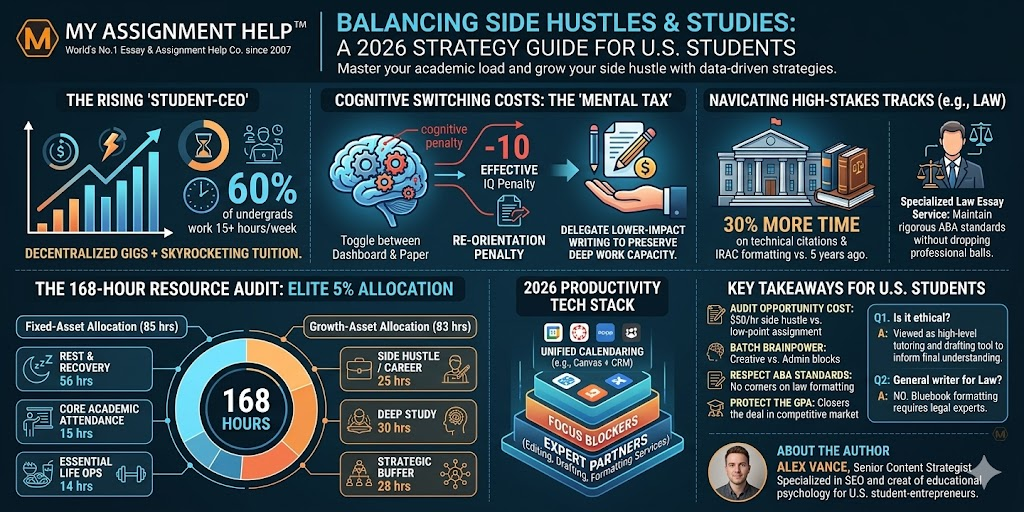
To dominate your schedule, you must treat your time like a venture capitalist treats a seed round. You have 168 hours a week. Here is how the “Elite 5%” of student-entrepreneurs divide them:
The Fixed-Asset Allocation
- Rest & Recovery (56 hrs): Non-negotiable. 8 hours of sleep is the foundation of cognitive performance.
- Core Academic Attendance (15 hrs): Lectures and mandatory labs.
- Essential Life Ops (14 hrs): Meals, gym, and hygiene.
The Growth-Asset Allocation
- Side Hustle / Career (25 hrs): Direct income-generating activities.
- Deep Study (30 hrs): Focused, distraction-free learning.
- Strategic Buffer (28 hrs): The “Hidden Margin” for networking, emergencies, and administrative tasks.
The 2026 Productivity Tech Stack
In the U.S. market, manual scheduling is dead. Top-performing students use a tiered stack:
- Unified Calendaring: Tools that sync your university Canvas/Blackboard deadlines with your professional CRM.
- Focus Blockers: Apps that lock your professional notifications during “Deep Study” blocks.
- Expert Partners: Professional services for drafting, editing, and formatting when the “Switching Cost” becomes too high.
Key Takeaways for U.S. Students
- Audit Your Opportunity Cost: If your side hustle pays $50/hour, spending 10 hours on a 2-point assignment “costs” you $500.
- Batch Your Brainpower: Do all “Creative” work (writing/designing) in one block and all “Administrative” work (emailing/filing) in another.
- Respect the ABA Standards: Never cut corners on technical formatting in law or professional degrees.
- Protect the GPA: In a competitive job market, your side hustle gets you the interview, but your GPA closes the deal.
Frequently Asked Questions (FAQ)
Q: Is it ethical to use an essay service for my degree?
In 2026, professional academic support is viewed as a high-level tutoring and drafting tool. As long as you use the provided research to inform your final understanding, it is a legitimate productivity strategy used by high-achieving students worldwide.
Q: How do I handle the 40% productivity penalty from task switching?
Use the “20-Minute Buffer.” After finishing a work task, take 20 minutes to physically move or meditate before starting a study task. This clears the “cognitive residue” of the previous project.
Q: Can a general writer handle my Law School assignments?
Absolutely not. Law requires a specific understanding of U.S. jurisdictional standards and Bluebook formatting. Always ensure you are using a specialized service that employs legal experts.
About the Author
Alex Vance is a Senior Content Strategist at MyAssignmentHelp, specializing in the intersection of SEO and educational psychology. With a decade of experience helping U.S. students navigate the rigors of Ivy League and State University requirements, Alex provides data-driven strategies for the modern student-entrepreneur.