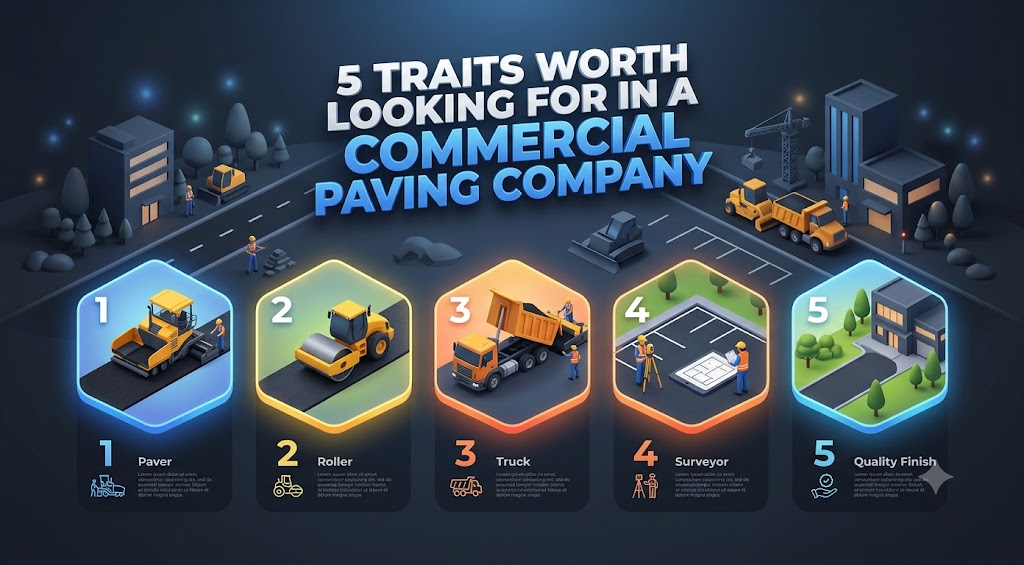
5 Traits Worth Looking for in a Commercial Paving Company
Picking a paving contractor for a commercial job is not the same as hiring someone to resurface a driveway. The stakes are higher, the scope is bigger, and the consequences of poor workmanship show up faster and cost more to fix. Parking lots that fail in two years instead of fifteen are budget problems and liabilities, and working with a commercial paving company that has the right experience, credentials, and approach from the start is what prevents that outcome.
These five traits tell you which companies are worth trusting with a commercial project and which ones to walk away from.
Trait 1: Experience With Commercial Projects
Commercial paving is a different discipline from residential work, and a company without genuine commercial experience will show it quickly on a larger job. Before you invite anyone to quote, check three things:
Questions to Ask Upfront
- How many commercial parking lots, roadways, or industrial yards they have completed in the last three years
- Whether they have worked with property managers, municipalities, or large commercial clients before
- Whether they can provide references from past commercial clients who will speak to the quality and timeline of finished work
Why Track Record Matters
Longevity in this industry matters because it takes time to build the expertise needed to handle complex jobs consistently. Companies that have operated for a decade or more have dealt with the kinds of problems that arise at commercial sites and know how to manage them without delay or costly mistakes. Parking lots, loading docks, and roadways all have different requirements, and the right commercial paving company will point to projects similar in scope and complexity to yours.
Trait 2: Strong Communication and Responsiveness
Poor communication is one of the most common complaints about contractors across every trade, and paving is no exception. Companies that are hard to reach during the estimate phase tend to be even harder to reach once the job is underway and problems come up.
Responsiveness Before the Job Starts
Responsiveness during the bidding stage is a reliable signal of how a company handles communication throughout the project. If it takes days to respond to a quote request, that pattern tends to continue well into the job itself. Pay attention to how quickly and clearly they communicate before they have your business, because that is usually better than what you get after.
Clear Updates During the Project
Commercial clients also need to plan around paving work. Parking lot closures, access restrictions, and curing timelines all affect tenants, customers, and daily operations. Reliable contractors provide clear updates on scheduling and any changes before those changes become problems.
They confirm scope in writing, provide a realistic timeline with milestones, name a point of contact for the duration of the project, and notify you promptly when weather or other factors affect the schedule.
Trait 3: Proper Licensing, Insurance, and Credentials
Licensing and insurance are not optional. Working with a contractor who lacks the proper credentials exposes you to liability that far exceeds the cost of the paving job itself. Before signing anything, verify all four of the following:
Credentials to Check Before Signing
- Current state contractor’s license: In North Carolina, commercial paving contractors must be licensed by the NC Licensing Board for General Contractors. Confirm the license is active and covers the specific type of work being quoted.
- General liability insurance: Protects your property if the contractor causes damage during the job. Request the certificate and check the coverage limit is appropriate for a commercial project.
- Workers’ compensation insurance: Protects you from claims if an employee is injured on your site. This is separate from general liability and must cover all workers present during the job.
- Industry affiliations or certifications: Membership in professional associations or manufacturer certifications signals that a contractor takes quality standards seriously and keeps up with current practices.
Trait 4: Quality Materials and Workmanship
The materials used and the care taken during installation determine how long a paved surface holds up. Cutting corners on mix quality or skipping steps in the installation process creates surfaces that look fine for a year or two before deteriorating ahead of schedule.
Material Specification
Commercial asphalt mixes are specified by thickness and aggregate composition based on the expected traffic load. Recommending the same mix for a low-traffic parking lot and a loading dock that handles heavy trucks reflects a lack of care in the specification. The right contractor explains why a particular mix or thickness suits your specific site conditions rather than applying a generic approach to every project.
What Quality Workmanship Looks Like on Site
- Equipment is appropriate for the job scale and not undersized for a commercial pour.
- Edges are clean, and transitions are smooth, particularly around drains, curbs, and existing pavement.
- Density testing is used to verify compaction rather than relying on visual checks alone.
- The finished surface drains correctly and does not pool water after rain.
- The crew follows proper curing protocols before opening the surface to traffic.
Trait 5: Transparent Pricing and Scope of Work
The lowest bid is rarely the best bid. In commercial paving, price differences between quotes often reflect differences in material quality, mix thickness, or the number of steps included in the job. Transparent, itemized estimates make it possible to compare quotes accurately and understand exactly what each one covers.
Clear, Itemized Estimates
Good estimates break the job down by component: mobilization, subbase preparation, material costs, labor, and equipment. Lump sum quotes make it impossible to compare bids accurately or understand what is being left out, which is where scope disputes start.
Subbase preparation and drainage corrections are not always included by default. Confirm in writing exactly what the estimate covers before signing anything.
Defined Scope and Warranty Terms
Warranty terms vary, so confirm in writing what is covered and under what conditions it applies. Push back on anything vague before signing.
For price changes, the contract should address three things clearly:
- What qualifies as an unforeseen condition that allows the price to change
- How changes are communicated before additional work proceeds
- Whether written approval from you is required before extra costs are incurred
Other Signs of a Reliable Company
Beyond the five core traits, a few additional signals help confirm that a contractor is worth working with before you commit.
Written Contracts and Portfolio
Written contracts are essential on any commercial paving project. The contract should cover scope, timeline, payment terms, and warranty. Contractors who push back on providing one in writing are best avoided.
Before committing, ask to see photos of similar completed projects and check whether edges, transitions, and drainage points look clean. Visiting a finished job in person gives the clearest picture.
References and Reviews
Ask for references from past commercial clients and pay attention to comments about communication and timeline as well as the finished surface. How a company handles problems matters as much as how the job looks when everything goes to plan.
FAQs
How do I compare commercial paving bids?
Compare itemized estimates rather than total price. Look at the mix thickness specified, what subbase preparation is included, the warranty terms, and the contractor’s credentials. Lower prices that reflect thinner material or skipped steps will cost more in the long run.
What should be included in a paving estimate?
Thorough commercial paving estimates should include mobilization costs, subbase preparation, material specifications and quantities, labor, equipment, drainage considerations, and warranty terms. Any item not listed should be clarified in writing before the contract is signed.
Why is insurance important for paving contractors?
Without adequate insurance, property damage or worker injuries that occur on your site can become your financial liability. Always request current certificates of general liability and workers’ compensation insurance before work begins, and verify that coverage levels suit the scale of the project.
Takeaway
Choosing the right paving contractor for a commercial job comes down to experience, communication, credentials, workmanship, and pricing transparency. Companies that check all five of those boxes are ones you can trust to deliver a surface that holds up, a timeline that stays on track, and a price that does not change unexpectedly once the job is underway.
Satterfield Paving has been delivering reliable commercial paving with over 45 years of experience in asphalt paving, concrete work, sealing, and striping. The team brings the kind of practical knowledge and disciplined approach that commercial projects demand. Every job is backed by a commitment to quality materials, honest communication, and work built to last.
Reach out to experts to discuss your next commercial project.
Read More: Crack Filling vs Crack Sealing: What’s the Difference?